
Rover’s largest cars may have been aspirational products when new, yet the last two decades have seen them depreciate badly, and many become scrapped as they reach the level at which they cannot depreciate further. With the earliest 75s beginning to reach this position, now is perhaps a good time to ask if history has been kind to the best of mainstream British. Sam Skelton pits three big Rovers against each other to find out if history should regard them well, and ultimately which he’d most like to take home.
Words: Sam Skelton. Pictures: Richard Clements, Richard Gunn, Jonathan Sellars, Sam Skelton
Group Test: Rover SD1 3500 vs Rover 827 vs Rover 75
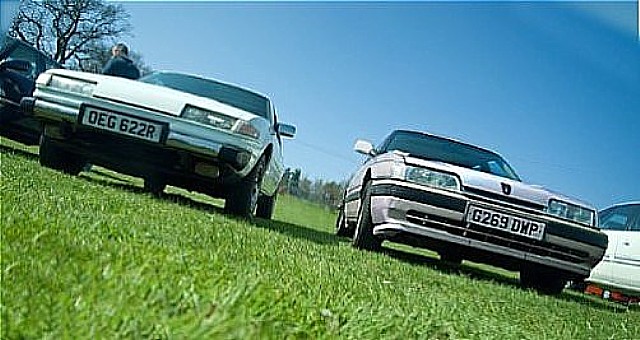
SD1 and 800 - very different cars, but should history treat them differently?
Introduction
Big Rovers have long been the executive car of choice for the chap who didn’t want a BMW, a Mercedes, or the upstart Audi. The Firm’s offerings all seemed to retain a touch of true class, whether mind-blowingly modern or unashamedly traditional, and coupled to the sense of patriotism when buying British this helped Rover to retain a favourable share of the marketplace.
But has history been kind to the most notable big Rovers of the last thirty five years? We test an SD1, an 800, and a 75 to find out how history should treat them, and which of the three we’d most like to take home. All were well received at launch, and all sold well – each peaked at over 50,000 sales in a single year. However, by the early 1990s the aspirational image Rover had held since the days of the P4, P5, and P6 was starting to fade. Rovers began to be seen not as the car bought to accompany success, rather as the car bought to accompany retirement.
Model Histories
The SD1 was developed as a successor to the Triumph 2000/2500 range and the Rover P6 range. Launched in 1976 to almost universal acclaim, it represented a huge departure from that which had gone before. Gone were the wood, leather, and Bakelite steering wheels of the past, to be replaced with soft-touch plastics, nylon seats, and the cleverest dashboard in all of time. The instrument binnacle could be mounted on either side of a symmetrical dashboard, allowing for increased parts commonality between LHD and RHD cars. In an Autocar comparison against its rivals, it proved not only the cheapest, but the fastest and second most economical. The Don Safety Award and ECOTY 1977 soon followed. In 1982 what many consider the definitive SD1 was launched; the 190bhp Vitesse. Quick even by 2010 standards, the car was both successful in competition and a popular road car, its successor would have to be pretty good to get anywhere close.
Ten years after the launch of SD1, the 800 was launched – much the same as its predecessor, initially only with the largest engine. And so the SD1 Vitesse, 2.3, and 2.6 continued briefly alongside the new Rover 825, with the last SD1s sold in 1987. The 800 was jointly developed with Honda‘s Legend, under the codenames XX and HX respectively. Utilising a brace of powerful 2.0 16v fuel-injected engines to replace the SD1′s sixes, and the Honda C-Series 2.5 V6 as a replacement for the Rover V8. However, the V6 was criticised at launch for its lack of mid-range torque – a shame then that Rover chose to push the Sterling model, as reports of the 2.0 models were favourable. Motor’s “We can’t think of a better 2-litre executive car” was praise indeed. In 1988, the 2.7 version of the V6 arrived – and with it came a new fastback body option. These were combined to create the Vitesse model – not, it has to be said, so aggressive as the SD1 Vitesse had been, but a quick and capable car nonetheless – the 827 Vitesse remains the only production car to have lapped the Isle of Man TT course at an average speed of more than 100mph.
In 1991 the 800 received a substantial facelift, to create the R17 (or Mk2) 800. Little really changed on paper – the 4 cylinder engines were revamped to produce greater low-range torque, the V6 Vitesse was replaced by a 180bhp 2.0 turbocharged 4 cylinder previewed in the limited run 820 Turbo, the interior received some small tweaks, and the majority of body pressings were altered to give a more upmarket, almost Jaguar-esque look. The following year saw the launch of the handsome Coupe in V6 form, later to be offered with a full complement of engines to Sterling specification. The later 200bhp Vitesse Sport became known in enthusiast circles as quite a driver’s car, yet because of the range’s somewhat elderly image and BMW’s desire to avoid in-house competition, its abilities were not as well-publicised as they could have been. In 1996, the Honda V6 was replaced by Rover’s own KV6. As nice an engine as the KV6 is, the early examples as fitted to the 800 became known for frequent head gasket failure, and ultimately destroyed what was left of the car’s reputation.
The 75 which followed was seen by all as a huge leap forward from the last 800s. Launched at the NEC Motor Show of 1998, its styling provoked – favourable – comparisons against the Jaguar S-Type; unveiled at the same show. However, its launch was overshadowed by BMW boss Bernd Pischetsrieder’s announcement to the press that the Longbridge factory may be under threat. The catastrophic timing of this announcement conspired with rumours of quality issues delaying production – the real reason being that the launch was moved forward by BMW, and production cars wouldn’t be finished until the following May – to give the 75 a bad start. Things weren’t helped by images of airfields crammed full of seemingly unsold 75s. Yet its done rather well for itself. Despite a hideous facelift in 2004, the range did achieve a certain degree of popularity, and when the MG models were unveiled in 2001 Rover had the sports brand to complement the waftomatic Rovers. The 75′s zenith, some argue, was the 260bhp MG ZT260 V8 and the equivalent automatic Rover, which lasted just two years before MG-Rover called in the receivers. The 75 is still being made in a couple of forms in China, although it isn’t expected to form part of the new MG range when the MG6 is launched in the UK.
The Cars
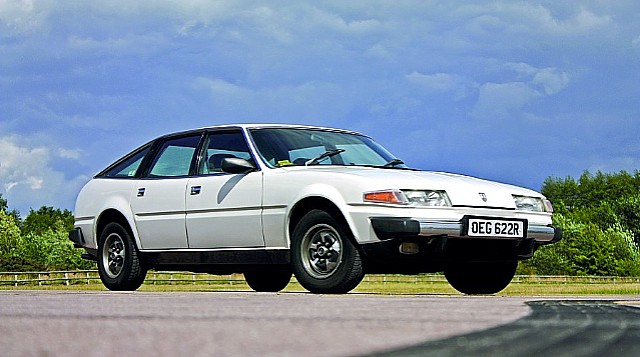
(Picture ©Richard Gunn 2011)
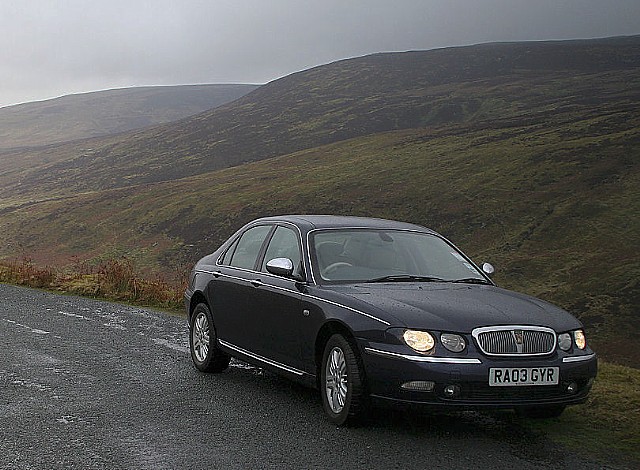
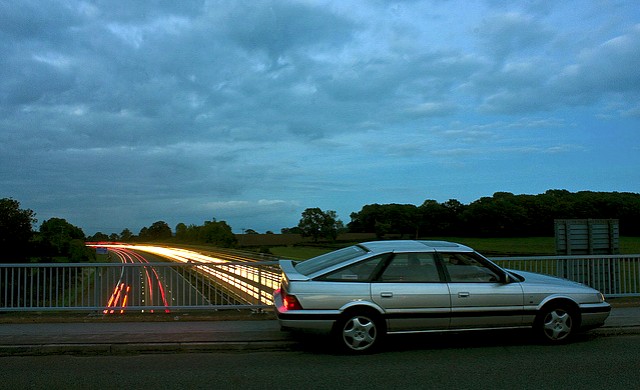
The cars we have on test are, arguably, the best examples of each model in the real world. Representing the SD1 is the Pendelican White 1977 3500 manual of motoring journalist Keith Adams, recently back from a three year restoration in Poland which has earned it the nickname of ‘Polski-Rover’. The 800 is a Pulsar Silver 827Si manual belonging to my old friend Richard Clements; his hobby car since 2008, and one to which he has made the odd improvement courtesy of the Rover parts-bin. The 75 we have is the 2.5 Connoisseur SE automatic of Maestro and Montego OC webmaster Jonathan Sellars, resplendent in royal blue with a cream leather interior; his daily driver since 2006.
Let’s start with the SD1. Personal memories on the part of the author make this an emotional moment, and upon turning the key and hearing the throbbing V8 erupt there is a feeling of instant gratification. Slip the large gearlever into reverse, take up the clutch, and release the handbrake. There’s a screeching. All is well, however, Keith assures me its just a loose bearing. First, and much the same happens, but we set off and the first thought that comes to mind is of sheer effortlessness. its a wide car – the handbrake’s some four miles over to the left of the driver’s seat, and the passenger may even be in a different time zone. When on the move, however, it seems to shrink round the driver – whilst still feeling big and lazy it felt to be more a big car impression than a genuinely large car. The gearbox is pleasant to use, and there’s plenty of feel through the assisted steering. The quartic wheel is intuitive to use – marketing mishap it may have been in the Allegro, but it really feels barely different to a conventional round one. The verdict, following a short drive, is that the V8 Rover deserves the accolades – it still feels fairly modern today, it rides and steers well, has oodles of torque and turns heads. its only real flaw is the fuel economy or lack thereof – and LPG can be your friend.
Swap into the 827, and it feels more familiar. Having reviewed a Startins Regency automatic, the author is familiar with the 800 – a direct comparison between manual and automatic would be interesting. Courtesy of Japanese taxation laws and the Honda-shared platform, the 800 was considerably narrower than the outgoing SD1. This is obvious inside – its by no means a cramped car, feeling airier than its predecessor thanks to a larger glasshouse, but everything seems to fall closer to hand. The 800′s static qualities, though enhanced on this example by the optional Roversport alloys, a boot spoiler, and a leather interior, simply aren’t anywhere near as good as those of the SD1. Neither, really, are its aural qualities – the V6 may sound good, and may be one of our favourite engine configurations – but compared to a V8 there really is no competition. But what surprises is the power delivery. Slip it into first and set off, and the car is raring to go, begging to be let loose. Same happens in second – feels like a scalded cat (No cats were scalded in the creation of this metaphor) and imbues the driver with a sense of confidence. Turn in is sharp, and the light steering is direct – we could like this car a lot. What surprised us was just how different this car felt to the automatic Regency – rather than a miniature limousine this Si seemed to feel like an unfeasibly big sportscar – more energetic and eager than calm. The ride didn’t disappoint either, and it was almost a shame to have to hand the keys back. The author is led to believe that the R17 800 doesn’t feel as sharp as the XX, and courtesy of emissions equipment the V6 certainly isn’t as powerful or urgent. The ride is also said to be compromised, so on that basis we would recommend an XX. However, a truer opinion will be given when the author has had an opportunity to test an R17 Rover 800.
It is widely acknowledged that the 75 was a better car than the last 800s. And from the cabin, it is easy to see why. The SD1 and 800 feel like what they are – fairly high range executive cars. The 75′s ambience conveys nothing quite so definite. Rather than a focused environment, the 75 puts one more in mind of the country squire, pottering about his estate with no particular place to go. It feels a far smaller car than the older Rovers – but then, it is – it’s descended as much from the Montego as it is from the 800. Yet it doesn’t have the attendant issues of riding and handling like a small car. Far from it. It seems not so much to ride as to float along in a wholly tranquil manner, disregarding anything so impertinent as a bump or undulation with, we fancy, a slight sneer. The steering feels remote in the same way – not so much a lack of feel but a sense of being cosseted and protected from the horrors of the outside world. The engine is near silent, and only one thing really seemed to jar. Some of the plastics used in the cabin served to shatter our illusion that we’d chosen the wrong car; that this wasn’t really a Rover but some tiny Rolls Royce someone had parked in its place. For what it is, its a feel-good car, and we can’t think of a car in class we’d rather have.
(Picture ©Jonathan Sellars 2010)
Conclusion
So, has time been kind to the best of British? In all three cases, we can say that on the whole it has. None disappointed greatly, and all are worthy of the place they either occupy or have reserved in the classic car world. But which is the best? The 75 is a worthy car, and a wonderfully peaceful way to waft away from the horrors of the office on a Friday night. But its not particularly exciting. The SD1 is a lovely car, but we think the V8 rumble and the sense of greatness the SD1 exudes are best saved for special occasions.
As a hobby car then, for high days and holidays, the Solihull sensation has it. But as a fun car that could be used daily, it has to be the 827. It’s capable of raising grins reminiscent of the most contented of Cheshire cats, yet it’s not quite rarefied enough yet to feel thrilling to so much as glimpse. And on top of that, it can do the relaxed act if not quite as well as the 75, then very nearly as capably. The problem with the SD1 is that one day, the V8 would stop sending shivers down our spines. It would stop thrilling us to know we had our own SD1. And that would be a truly devastating occasion – a daily classic needs to be something less evocative yet just as good. To settle the matter, take a look at the prices of the few 827s left. We were offered a good Sterling a few weeks ago for under £500, and they’re out there for half that. Its the upcoming classic bargain of the century, and it would be mad not to consider taking the plunge.
(Picture ©Richard Clements 2010)
Thanks to Keith Adams, Richard Clements, and Jonathan Sellars for the loan of the SD1, 800, and 75 respectively.
