
Rover and Jaguar have always been a well-matched pairing – from the days of the ‘S’ Type-driving baddie being chased by a succession of police P6s and SD1s, right down to the Rover 800 which in Sterling guise served as a poor man’s XJ in the 90s. Both are typically British too – the stereotypical Brit John Steed had both an SD1 and a super XJC in the New Avengers. So it’s apt that both marques have created retro saloons in the same field. Sam Skelton compares the two to see which is best.
Words: Sam Skelton. Pictures: Sam Skelton, Jonathan Sellars
Back to Back: Jaguar X-Type 2.5 SE vs Rover 75 2.5 Connoisseur SE

Introduction
“Retro” has been a big thing stylistically over the last decade or so as far as car manufacturers are concerned. Some have done rather well, yet some have fared rather worse. Jaguar, for instance – few share my opinion here, but the S-Type is poorly styled and I have every confidence that Geoff Lawson’s team (as it then was) could have done far better – indeed, the 2004 facelift worked wonders and made it an almost desirable shape. The VW Beetle is worse still, and don’t get me started on BMW’s MINI range.
But two which work rather well are Rover’s 75 and Jaguar’s X-Type. Styled in manners very reminiscent of the Rover P6 and Jaguar XJ6 Series III respectively, the cars happen to be competitors not just on the retro styling front, but in the showroom when new. So which is best – not just from a style perspective, but which would I rather take home and park upon my driveway?
To truly compare models, we have to take the very top of the Rover range and compare to the middle-range Jag. This means a 2.5 Connoisseur SE automatic representing Longbridge, and a 2.5 SE automatic representing Halewood. Well, they had to be autos – one couldn’t have a Jaguar with a do-it-yourself box! When new, both cars would have been somewhere in the region of £25000, depending upon the options chosen and the buyer’s ability to haggle.
On paper, there are fairly big differences between the cat and the Viking longship. The Jaguar has four wheel drive in place of the Rover’s front wheel drive, and a cool fifteen brake horsepower over and above the Rover’s 177. Little surprise then that it’s sprightlier, but to base your judgment upon performance is to miss the real point of these cars. A small Jaguar should be about waftability upon a scale that isn’t stupid – something that the Rover also has won praise for.
But forget the dynamic qualities of both the Rover and the Jaguar for the time being. The real reason for the back to back test is after all the styling – both are unashamedly retro, so we must see not only how they compare to each other, but how also they compare to their inspirations.
Style
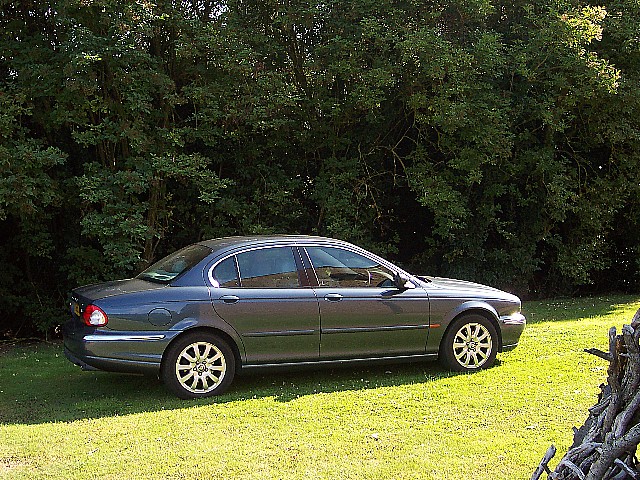
Let’s look at the Jaguar first. The grille leans forward in a shark-nose manner that one first associates with BMWs of the Seventies and Eighties, but when we consider the nose of a Series Three XJ it fits perfectly. The side elevation is clearly related to the Jags of old – even Stevie Wonder could see the hips, the flowing waistline, and the long boot aping Arfur’s favourite set of wheels. There are even very subtle creases to the tops of the X-Type’s wings – only visible from the right angle or in the right light, but once again a homage to the classic Jags we know and love.
The Rover is even more retro than the Jaguar. With barely a glance it is obvious that this is a modernised P6 – the V8 grille of some later models only adding to this illusion. The glasshouse could have been lifted straight from the Bache bruiser, and the gently swollen sides of the P6 are well-replicated here. We even have classically styled door handles, so as not to spoil the lines. It’s a shame really that the car wasn’t offered with a vinyl roof, hubcaps, and a boot-mounted spare just to complete the illusion.
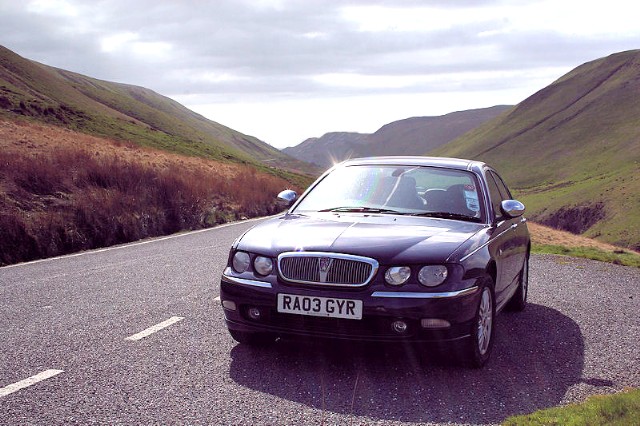
(Image copyright Jonathan Sellars)
Sadly neither Jaguar or Rover could leave their cars alone – the Jag sprouted a grille resembling the nose of Daniella Westbrook, and the Rover fared worse – a nose job which could be applied to a Skoda and not look out of place. The Rover was partially saved by the V8 model’s deeper grille, but it still used the world’s most awfully shaped headlights and, um, interesting use of creasing – the Jag’s single nostril and reworked rear leave a lot to be desired and saving graces are few. Both companies should have realised that the modernisation of a retro design rarely works, and I suspect that in both cases the early cars are the ones everyone will want in twenty years’ time.
Despite the fact that I could rhapsodise about the styling of both cars all day long (and well into the night if need be), I can put off the inevitable road tests no longer. I have the enviable task of driving both cars ahead of me, to establish how well they measure up on the road as well as from a stylistic point of view. Truth be told, despite the fact that on paper the Jaguar seems to be leagues ahead of the Rover, I’ve been looking forward to comparing the two – and the examples I have on test are not as disparate as at first you may think. Toss a coin to determine the order of trial, heads I drive the Rover first, tails the Jag. It’s heads, so I hop into the 75.

(Image copyright Jonathan Sellars)
Behind the wheel
Jonathan Sellars’s 2.5 Connoisseur SE is the highest spec Rover did, which means electric everything. Even the lower models, those without leather seats or many toys, get a gorgeous lump of walnut for a dashboard, magnolia dials, and a steering wheel that could have come from a yacht. This car adds the heady smell of hide to the furniture polish aroma already present, with the warm creams and sober black trim inviting you in. Some of the interior plastics – notably on and around the gear selector – feel low-grade, but on the whole it’s an impressive experience and one for which you would expect to pay far more. Shut the door and it feels like a cocoon – I’m 6’3″, and whilst it wasn’t cramped people of my build will feel a tad hemmed-in inside the 75. Not that that’s bad – the car envelops you like a duvet, to cosset and warm you. The back seat’s even better for a big man – space aplenty for the longest of legs and the highest of heads. On the move, the ride matches the interior – it cushions you from anything so unseemly as a bump, and the seats cosset you to the extent you start to feel slightly light-headed. It’s a very ‘Pomp and Circumstance’ car – it makes you feel proud to be British and acts as a potent reminder of just how good we were. People have described the 75 as a baby-Bentley – it shows.
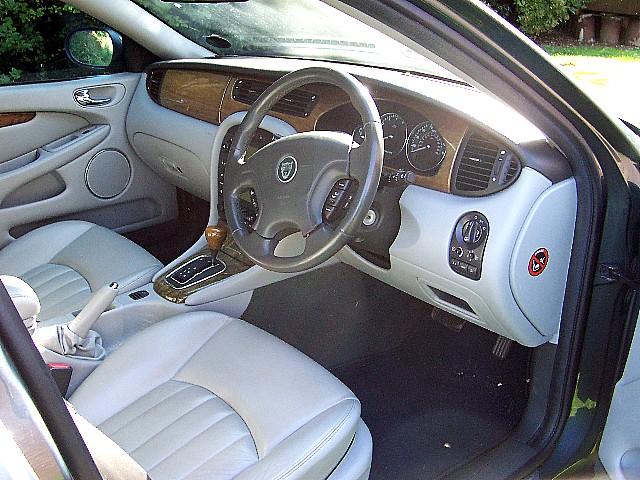
How does Paul Skelton’s X Type 2.5SE compare? Well, spec-wise it loses little to the Rover, though there are few spec additions over and above the Longbridge lounge-lizard. The CD player in the Rover has been substituted for a cassette player – but I don’t mind this; much of my in-car music collection is on cassette anyway. The walnut dash is gone, replaced by a slab of maple, and on the test car creams and blacks give way to a more businesslike grey interior. Perhaps it’s me, but I’m not so sure it’s as inviting as the Rover – it somehow seems less warm and friendly to behold. When inside, you sit lower on a firmer seat, and the quality of the interior plastics seem somewhat better than the Rover’s. In the right weather, it can almost match the interior smell, but on ambience the Rover has it. On rear space too the Rover is streets ahead – I have less legroom and virtually no headroom in the back of the Jaguar. Surprise of the day is just how similar the X-Type dashboard design is to the Rover 75 – a car launched three years earlier. I can only put this down to Rover’s design being influenced by traditional Jags such as the XJ series, and in reviving their past Jaguar have unwittingly come closer to Rover in terms of design than they may be comfortable with. The Jag’s green dials and slightly more raucous V6 belie it’s ‘wafter’ image – despite being the SE model this is certainly a more sporting car than the Rover could ever dream of being. Turn-in is quicker, and the car does feel more alert and agile than the Rover. However, the ride is a tad fidgety on all but the smoothest of surfaces – it depends really what you want from your small executive saloon as to which you would prefer.
Conclusion
So two cars, and two things to analyse. Could this review end with that most boring of results; a tie? Well, as far as the retro styling goes, I feel that the Rover mixes the old with something a tad different. Despite the X-Type’s rather good attempt at being a small and modernised XJ SIII, replace the front and back with something contemporary and there’d be more than a hint of BMW about it. Couple this to an interior ambience which seems a tad too businesslike for a retro wafter, and you start to see why cosmetically it has to play second fiddle to the Rover.
On the road, as I’ve said it depends whether you want a sporting saloon or a luxo-barge – it’s the decision that people would have made in the late 1960s when faced with either a Jag 420 or a P5B. So it would be a fallacy to assume that I’m 100% right unless your motoring tastes happen to agree with mine. I like to waft – flooring it round country lanes has a limited appeal for me, whereas getting from A to B as smoothly as I can is one of my motoring ambitions. Why else, after all, do you think the Bentley Turbo R is my dream car? So for me it would have to be the Rover – the Jag’s a very close second, but the 75 just does what I want a car to do more capably. It’s also cheaper – on the secondhand market our test cars are closely matched despite the Rover having two fewer years under it’s belt. Try to find me a good X-Type for under two thousand pounds. Now take your pick from any number of high end 75s for half that.
My case rests.
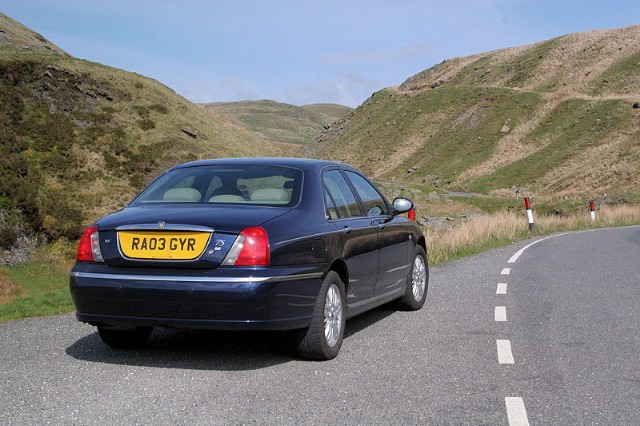
(Image copyright Jonathan Sellars)
With thanks to Paul Skelton and Jonathan Sellars for the loan of the X-Type and 75 respectively.
