
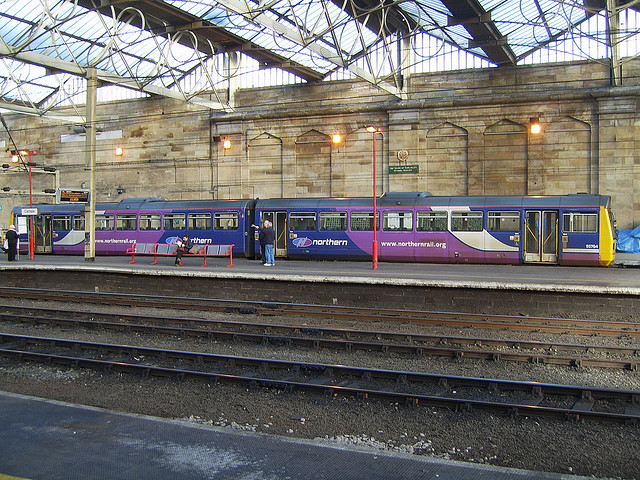
Are these really the way to service commuter lines?
As most readers of this site SHOULD know by now, I’m a bit of a fan of Leyland. Mention the word Allegro and I’m in heaven, I’d rather like to marry a Princess, and spend the honeymoon in Montego. There’s little in the canon of BMC>MG-Rover that I would not like to own at some point, and many happy memories have been formed in end of life Rover tin.
However, there are some exceptions; exceptions that I have endured for many a Godforsaken mile. I don’t really like the Ambassador; it may have gained a hatch but it also gained a load of features that basically made it more bland. The Ital was a way of kidding people into thinking a facelift of a ten year old stopgap was a new car. I can’t see myself owning an Amby, and frankly I KNOW Ital ownership ain’t on the cards. But the third of my hates is a vehicle in which I have travelled several thousand miles over a number of years. I am, of course, talking about the Class 142 Pacer railbus.
Surprised? I love rail travel. I spend days on preserved railways for fun, chugging about in steam or diesel units, whiling away time by travelling back in it. For long distances the train is the clever option – you can work, read the Telegraph, listen to music, or spend hours on the phone. It can also be far quicker than travelling by car, and you don’t have to waste time parking at the other end. I love BL – by and large. I love the 1980s – and the Pacer is a product of that decade. Yet if we combine 80s, Leyland, and rail, we are given a one way express ticket to Hell, with Satan as the driver and his horde of demons as the conductor-guards.
I live in Sheffield. A city renowned for its flatness. Oh, hang on, I meant a city renowned for hills. One of which I live on. In the recent chilly period, we’ve had several threats of snow – the most recent of which was due to hit just before I left Huddersfield on Thursday. So I decided to do what I knew to be the sensible thing; to revert to tradition and hop on a train rather than risk being unable to get home in the mighty Montego.
Leaving the house at 7.20am, I arrived at Meadowhall station and bought my ticket for the 07.42 – a train I caught an average of three times a week over two and a half years. My hopes weren’t high – this time had made me well aware of the Pacer’s shrotcomings. Fellow BL enthusiast Keith Adams expressed an interest in Pacers recently, and as a frequent user I felt qualified to comment. “Traumatic? I got through the trauma a long time ago, moved on to dread, learned to sleep on public transport, found that was no longer viable, tried blanking it out with newspapers and music and eventually even that became too much to bear. Started giving serious thought to commuting Sheffield to Huddersfield via Manchester in order to escape them!” Naturally, this made Keith head north from Northamptonshire to Leeds to try one.
“At no point in the design brief were the words ‘enjoyment’ or ‘comfort’ mentioned. We can only hope they’re cheap to ride on. There’s no choice for it, but to make sure we enjoy the rest of the day by avoiding the Pacer and so that’s what we do.” If a serial BLcoholic, who travelled a fair distance SOLELY to go on a Pacer, decided he was going to avoid them all day – they must be worse even than I remembered.
So was my £11.30 return – some £3 more than it costs in fuel – worth it? Let’s examine some statistics. It wasn’t cheaper. I left the house forty minutes ahead of schedule to arrive at the same time in the university library – bear in mind that it’s ten minutes walk further to where I park than to the station – so it took considerably longer than the usual hour. Comfort? Well, I got home with a bad back that still hasn’t gone away over a day later, aching knee caps, and stress from the added noise. There’s also next to no space for a six foot two long legged Northerner in a Pacer. The 144s ride better but are still awful. People say it’s grim up North – they must have ridden on a Pacer.
So does the Class 142 have ANY plus points? Are there ANY reasons why one should take the Pacer rather than a car? Well, for we BL people there’s a distinct resemblance to the National, which shares some panelwork. But I drive a Montego – however I choose to travel I’m immersed in the Firm. Six people can travel together on a Pacer, I suppose – they can’t in the Monty. But most of my travel is alone.
The ultimate plus point is that it means I don’t risk writing off the Montego in inclement winter weather. But here fate dealt me a losing hand; for not only was there no snow or ice by the time I got on the train, none formed at all.
I’ve ranted, so I’ll finish. Do I hate rail? No. Do I hate BL? No. Do I even hate the journey to Huddersfield? No – for on a Class 158 it is a joy in summer or winter, views you would not believe unless you have seen them. I don’t even hate the 142 – for I can see the merits of the railbus on smaller lines, and the National-esque body appeals to me. What I loathe is the fact that certain rail operators consider the cheap option from thirty years ago to still be acceptable for busy commuter lines. There are better ways to achieve the same end – it cannot be costlier to run a coach service, or to substitute newer units when they are withdrawn from larger lines. Granted, a Pendolino probably wouldn’t work on anything but a main line but Class 158s and similar units would do the job.
As a petrolhead I shouldn’t advocate public transport, but inevitably it will become the only viable option – and there are two ways to achieve this. Price most drivers off the road, or make public transport the attractive option. And methods of pricing people off the road will inevitably hit those with no options and also those who have been forced to change; prices will rise due to increased transport fees, and an increase will also affect the rail and bus industries. Transport is vital to stimulate the economy – and we all know it needs some stimulation. If I could get from door to door in an hour, in comfort, for the equivalent to the cost of petrol, I would probably take the train half the time. It cannot be that hard to achieve.
So why should we put up with less?

You are complaining about trains in UK? Just click on the link and look at the picture of the inside of an Angolan train. Go on, have a look and then really eat your heart out!
http://www.gazetadeluanda.com/noticias-de-angola/caminho-de-ferro-de-luanda-com-servicos-de-primeira-classe-3141.html
“What I loathe is the fact that certain rail operators consider the cheap option from thirty years ago to still be acceptable for busy commuter lines.”
Sam, you’ll find that rail operators can ask for certain types of train, but allocations are down to the Department for Transport. Also, one of the many ‘benefits’ of the joke that was privatisation is that our private rail operators on limited length franchises have little or no interest in investing their own money in replacement trains. Hence why the Government still has to stump up cash for new rolling stock. Your local train operator will also only dust off a Class 142 for you every morning when they’ve received a handful of cash from the local PTE. If there were no service subsidies, most local commuter trains – despite many being full – simply wouldn’t run. They make no money. There’s shareholders to think of before you get a new train…let alone a useful service.
I should imagine if British Rail were still here, by now you’d only be able to ride on a Class 142 on the K&WVR!
Luckily I don’t like trains. I say lucky because the nearest station to my house is also the nearest station to my office so its never an option for commuting. There are no buses from my house to the station either so its easier to get to the airport. All of this means I can get to Warsaw in less time than it takes to get to London. Which is also lucky because I like Warsaw.