
Sam Skelton continues his look at the mistakenly maligned motors of yesteryear with the Jaguar XJ40
The Jag that time forgot

Three XJ40s - is this any less desirable than other Jags?
The Jaguar XJ40 is oft-maligned in the world of classic Jaguars. Despite being technologically advanced and second to none in ride comfort at launch, it’s always been seen as the poor man’s Jag. The poor relation. The one that wasn’t quite ‘one of us’. I’ve attended Jaguar events at which XJ40 drivers have been shunned for their choice of car – and I think the time is ripe for change.
It’s seen as a bit ‘new’ to be a classic, still. Yet the oldest XJ40s are now twenty five, nearly twenty six years old, and even the newest are getting on for eighteen. By 2004 the then-25 Series III already had a cast-iron classic reputation, and even the last of those are only two years older than the newest XJ40. So why can it not claim its place in the pantheon of greats?
Favoured by captains of industry as well as shady spivs with a lockup in the East End, the XJ40 was the second most electronically advanced car in the world when launched in 1986 (The famously glitchy Lagonda taking the top spot). Available at launch only as a four door saloon with a choice of two AJ6 engines, two gearboxes, and three levels of trim, it replaced the six cylinder variants of the Series III. More trim levels and two new engines appeared as time went by. The Series III continued alongside the ’40 in V12 form, however – fearing the enforced use of the Rover V8 engine in the XJ by BL bosses, Jaguar reportedly ensured the engine bay was too narrow to accommodate a V-shaped engine. Whilst some former employees have refuted this tale, the V12 engined XJ40, dubbed XJ81, necessitated a revised underbonnet layout in order to accommodate that engine in 1993.
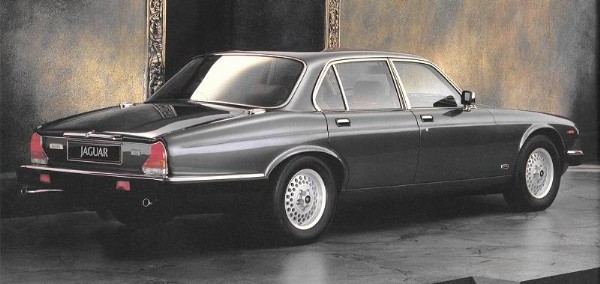
Sovereign V12 SIII continued alongside XJ40 to 1992
Whilst thirsty, the XJ81s are certainly superb modes of transport – find one with LPG and get yourself a lottery win, and you’re onto a winner. Collectors will undoubtedly stray toward the Majestic limousine, the TWR Jaguarsport XJRs, and the Chasseur Stealth supercar as rare and collectable variants, but with rarity and desirability comes an increased price tag. Nice though these may be, it’s worth leaving them to the collectors. What might be worth keeping an eye open for are late cars of any spec with options from the Insignia list – rare and unusual, the Insigia list included special colours and interior treatments. If you find one being sold by someone who doesn’t quite know what he has, leap at it – they’re already collectable and values are sure to increase. However, to dwell on the V12, the TWR, the Chasseur Stealth, the Majestic and Insignia is to commit a folly; these are recognised as collectable cars by dint of rarity. The real unsung heroes are the more common variants.

JaguarSport XJ40 one of the collectable variants
For those of us with deeper pockets and shorter arms, there are still some tempting propositions. The rule of thumb with XJ40s is to buy the best spec you can, and make sure it all works. Nobody wants manuals, steel wheels, metric alloys, solid paint, or tweed seats. Avoid the 2.9; it’s not exactly powerful (165bhp in an XJ40 doesn’t go too far) and no more frugal than the bigger engines. And everybody wants air con. So if you find a 2.9 XJ6 manual on metric steels, in Signal Red with grey tweed and no aircon, only buy it if you want to keep it long term and need never sell. Tempting though it is to have the only one left in such a lowly specification, you’ll never sell it and the chap you bought it from will scarcely believe his luck. The smart money buys dark metallic Daimlers and Sovereigns in 3.6 or 4.0 guise, or the more youthful 3.2S and Gold models. The smart money needn’t pay a bomb for it either; two grand will buy a very presentable one, and tatty ones can be yours for three figure sums.
I can hear you, though. You’re asking “Where’s the catch? An affordable classic Jaguar with plenty of kit and some very collectable variants, why is this being touted as an unsung hero?” And I’ll tell you. Because XJ40s are so common, and so many have been neglected, it’s still a bit of a banger in the eyes of most. Certainly, it’s the cheap way into Jaguar ownership. Before the X Type and the S Type, there was no more sensible way into Jaguar ownership – and this led to many unsavoury sorts getting hold of them.
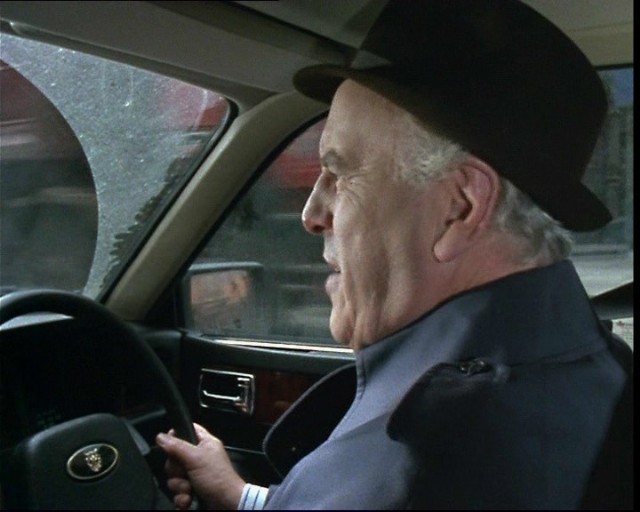
Arthur Daley in his XJ40 - nowadays he'd see one as a nice little earner!
That’s an image the XJ40 has never managed to shake off – a spiv’s car, a bit dodgy, something you wouldn’t want to associate with. Add to that the hatred we have of our nationalised car industry, and it becomes easier to understand – the XJ40 is tainted by birth as a BL product. There’s the styling too; sharp suited and swish it may have been when new, but fans expect a Jaguar to have curves. All the XJ40 can offer is a set square and a droopy boot. All that tends to overshadow the fact that Sir William Lyons himself was a fan, and that as a better seller than the Series XJs before it the XJ40 must be getting SOMETHING right.
The chief problem the car faced though, was that the models it replaced and preceded are Jaguars of the ‘classic’ mould – olde-worlde, svelte, curvaceous, and somehow RIGHT. The XJ40, with its advanced semi-digital dash, complex electronics, and razor edged look never quite captured the public’s hearts in the same way. That digital dash proved problematic, too – by 1990 it had gone, replaced by a more classic binnacle with six analog dials. The electronics in early cars were glitch-prone, though it’s safe to assume the worst offenders will have long ago become bean cans.
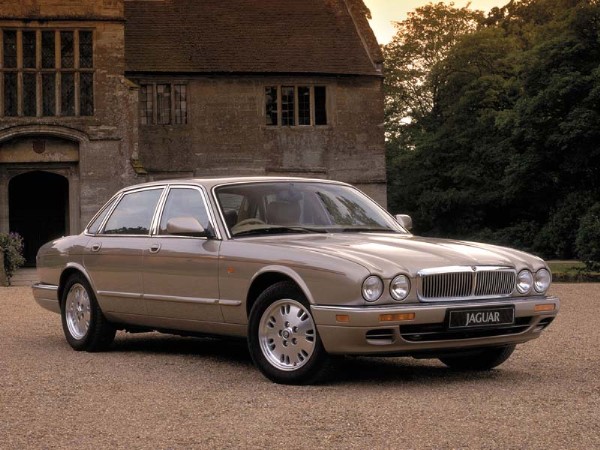
The X300 was more retro in style - but many think it retrograde in other ways too
If that lot puts you off, then fair play – though I’m told by owners that a sorted XJ40 is a superior car to the X300 which replaced it. In short, it’s seriously worth considering if you want an imposing barge or classic, to be used daily or for the season. Take a look at what it can offer you, and ask where you can find the same blend of imposing looks, cosseting comfort, effortless image and a sense of patriotism without spending much more. You might find the list of alternatives rather short.

That iconic design did eventually win the L’Automobile più Bella del Mondo albeit in XJ8 form.
For me, though, the nicest of the lot were the Daimler Double Six Coupes of the seventies.
Prodigious thirst but good for 140mph, an anorexically thin steering wheel but like many size zero models, surprisingly elegant when so beautifully clothed in that sveldt bodywork, all that glass which when wound down was remarkable for the absence of pillars. The best thing since the Iso Rivolta IR 300 of the sixties although choosing between them, for me anyway, would be as hard as choosing between Kylie Minogue and her sister. Would that I could afford both. Or all four, thinking about it…
As a young lad of the fuel crisis of ’73 led to my father cancelling his order for an brand new XJ12 in BRG- I felt I’d lost out.
In my late teens the sale of my TR6 didn’t go through fast enough and my best friend bought the very early chassis number E type instead.
A mortgage beckoned and the opportunity of a sublimely gorgeous navy blue Series3 DHC V12 was too much at £7000.
Somewhat more mature (ok! more grey hair) I have a XJ40 4.0lr Sovereign in Flamenco with Doeskin trim and lattice alloys sitting on the drive….
What are dreams for, if not to come true?..
The XJ40 is a beautiful car – to look at, and to drive. What’s wrong with these people? I have a 1994 3.2S, cost me less than two grand two years ago, having done just 65,000 miles. I drive it every day. Keep your E-types and all that stuff. A car should be driven; not kept locked up in a garage and taken to some ponsy show a couple of times a year. Even if you only keep it for a year or two, you’ll never regret it.
Agree 100% with your comments on the XJ40. As a much younger and more affluent single I had a Mk VII, then a Mk IX followed by a Mk.2. On my retirement I ditched my Nissan wagon in favour of a 1990 XJ40 Sovereign and have enjoyed my toy ever since. It does not do much mileage but when it does, it is a joy to drive and it completely ignores the post-earthquake Christchurch NZ, road damage that made the Nissan bounce wildly.
Cost me $2000NZ (about 1000GBP) and I have spent about half that again on maintenance to bring things up to spec. A luxury ride that still performs well when leadfooted.
I own a 1994 4.0S in Colchester Grey with beige interior, I love it it is by far the best car I have ever driven smooth nimble fine handling and luxurious, I want to keep it forever and will do all I can to make it so, I drive it every time I need to go out and she returns 23 to 28mpg
I own a 1998 XJ Executive, very rare find as manufactured with the 4L power plant, I’ve owned some great cars over the years including a new Porsche Caman 3.2L S, good car but very tinny, also a BMW 335 twin turbo, absolute pain in the arse always going into safe mode and BMW love to charge you £500 to turn off, anyway my Jaguar is by far the best car I’ve ever owned, totally pleasurable to drive, plenty of power, had for 4 years and never had a single problem, I truly believe this is a classic not to be sniffed at.
I worked my way through a series of increasingly powerful Rover cars, culminating in an insanely powerful, heavily modified (engine and transmission mods, I mean. My car didn’t look like the General Lee or anything.) 820 Vitesse fastback, BRG. This car was dyno’ed as 244 bhp, and could go 153mph. I destroyed this car in September 2007 when I rolled it into a ditch. I bought another, 1998 Vitesse saloon (again in BRG) about a month later, and drove it for nigh on 70,000mls, with only the tiniest of mods (a SS exhaust and a K&N air filter) until 2014, when rust finally got the better of her, and another MOT was just beyond her.
I didn’t consciously decide “I’m sick of steel cars, and the constant welding they want, it’s time to buy an aluminium car”, but I did spot a Jaguar X350 for sale locally, for just under 4 grand. It was ten years old, full JSH, and 99k miles.
Now, I have always loved the Jaguar XJ. I grew up almost aspiring to this car, as my father had a job which provided him with company cars, always Leylands, but never further up the range than Austin 1800s, or Triumph 2500s, at a pinch. He was once loaned an XJ6, while his (admittedly attractive, in Oxford Blue with cream velour interior) Austin 1800 was being repaired, and for a week it felt like we were in a different world. The Jaguar XJ, whenever it was built, from 1968 onwards, has always been the car you want a lift in, the car you want a look under the bonnet of, the car you want to go to a wedding in, and the car you own when you feel you deserve it. Even with Jaguar’s massive heritage, and huge output of famous and recognisable cars, the XJ remains the car which leaps to mind when people think of “a Jaguar”.
The design of the XJ was the last offered by Sir William Lyons, and it is perfect. Like a shark, evolution was unnecessary, it’s tucked in tail, it’s broad haunches, it’s four lamps, it’s perfect line. Always better looking than the Rolls-Royce Silver Shadow, just as well appointed, half the weight, just as comfortable, miles and miles faster, and a fifth of the price.
As a youth, and an absolute petrolhead, I collected car brochures, and the absolute gem of my collection was the 1975 Jaguar XJ range. A boy in my class at school, his dad had a V12 Coupe. The Jaguar XJ12 was technically a ‘supercar’ (although, it still topped out at a little over 140mph. My 2004 XJ6, with it’s little Ford-built 3 litre V6, can do 145mph) and by the time the ‘XJ40′ arrived, you could have a 2.9 litre straight six with a manual gearbox, fabric seats and steel wheels, and a letter from the dealer saying “Best of luck selling that.”
I consider my car the last of the XJs, certainly the last of the XJ6, and the model which now bears the name (since 2009, the current XJ, which starts at just under £60,000 and goes to over £90,000) to be contrary to the ethic of Jaguar saloons, which traditionally were built to be affordable.
Unquestionably, the current XJ is a truly fantastic car (the XJ-R is a massive, luxurious, unbelievably fast, hugely equipped car. But for 90 grand, of course, it should be.) and I wonder if we’ll see them in scrapyards (sorry, Vehicle Recycling Centres) in the future, where we can salvage the ignition switch, or the thermostat housing, or the little light in the ashtray. Maybe not.
My Jaguar is made out of aluminium, so it’s body won’t rot, and it’s engine and gearbox are sound. I’ve spent the best part of 3 grand putting it’s suspension and brakes right. I think I might just have the Jaguar of the future!